Sunday, July 21, 2013

Sermon: Only One Thing


Sermon for Pentecost IX - Proper 11C
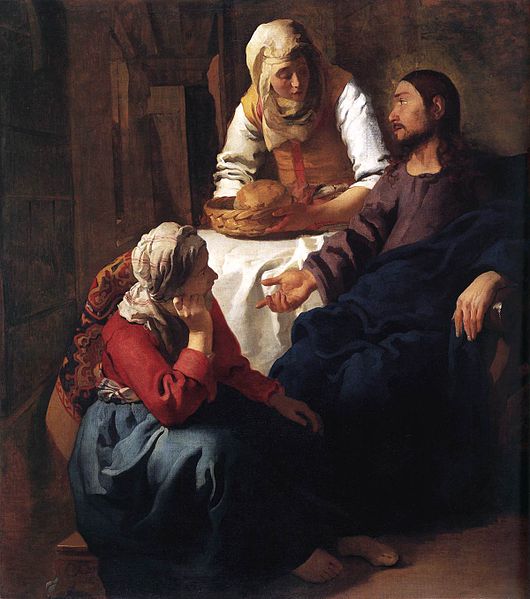
St. Philip’s In The Hills Parish, Tucson, AZ
The Rev. Vicki K. Hesse, July 21, 2013

Lectionary readings for the day, click here
Sermon based on Gospel According to Luke 10:38-42
I speak to you in the name of ONE God+. Amen.

In the 1991 movie City Slickers,
there is a touching scene between the gruff and leathery
cowboy “Curly” and
clean-under-the-fingernails city slicker “Mitch,”
The two are riding their horses side by side and
although these two had clashed for most of the movie,
riding along together they connect over
a conversation about life. 

Suddenly, Curly reins his horse to a stop
and turns in the saddle to face Mitch. 
Curly asks, “Do you know what the secret of life is?”
Mitch replies, “No.”
Curly smiles and says, “This (holding up one finger).”
Mitch says, “Your finger?”
Curly explains, “One thing.  Just one thing.   
You stick to that and everything else don’t mean *bleep*.”
pause
Mitch says, “That’s great but what is the one thing?”
Curly says, “That’s what you’ve got to figure out.”[1]

pause
That “ONE-thing moment” inspired the recent
NY Times best selling book The ONE Thing[2]. 
The book says that by focusing on ONE thing,
you can achieve extraordinary results. 

I think this is what Jesus had in mind when he said to Martha,
“you are worried and distracted by many things;
there is need of only ONE thing.” 

You may remember last week’s Gospel where
the lawyer asks Jesus, “What must I do to inherit eternal life?”
And after some prompting, the lawyer recalls
You shall love the Lord your God with all your heart,
and with all your soul, and with all your strength,
and with all your mind; and love your neighbor as yourself.”

But “who is my neighbor?” the lawyer asks.
In reply, Jesus tells about the Good Samaritan and
reiterates, “Go and do likewise.” 

The question “and how shall I love the Lord my God?”
hangs in the air. Part 2 of this story starts here.
Today, we enter a story of a woman who breaks the rules
by listening to Jesus’ teachings while her sister
works in the kitchen…
Neither the lawyer in the first story nor Martha in today’s story
understands Jesus.
It is the two stories together that illustrate the scandal
that radical obedience to Jesus requires[3] and
what it means to be a disciple.

pause
As Jesus and his disciples continue
on their dusty journey to Jerusalem,
Martha and Mary invite them to their house,
to take off their sandals and rest awhile. 
Martha was faithful to the tradition of hospitality
begun long ago with Abraham as read in Genesis. 

When three angels of the Lord showed up in Abraham’s tent,
he offered them hospitality and turned
to Sarah for her to help,
just as Martha turned to her sister Mary to help.

However, when Jesus arrives,
Mary simply plops herself down on the rug at Jesus’ feet. 
Who could blame Martha for chopping the vegetables loudly,
banging a few pots in the cupboard
and putting the plates on the table with a thump
so that Mary would get up and help? 

Mary was sitting at J’s feet –
acting like a male disciple,
neglecting her duties
and bringing shame on the house.
Mary did not fill the role as that society prescribed.

Martha’s protest is justifiable;
the tasks needed to prepare the meal distract her
from why she is offering hospitality at all.

pause
And her sister Mary’s odd behavior puts her on edge.
Although Martha is filling the role that society prescribed,
Her many tasks distract her from hearing the word of God.


In spite of all the changes between then and now, 
sometimes our many tasks distract us from hearing the word of God 
or from noticing when the Divine draws near..

*sigh* It just seems like there is so much to do –
taking care of our family, pets, the household;
holding down a job and engaging in ministries –
helping with the food pantry,
caring for the poor,
standing up for justice.
Sometimes, doesn’t it seem we are too busy doing God’s work 
to think about where God is in the midst of it?

pause
Yet, our roles prescribed by society / our culture seem
to draw us into a habit of
doing more, pleasing more, serving more.

And, for all the good we get from technology,
it doesn’t help us in this area. 

Linda Stone,[4] a thought leader in innovation
researches the physiology of our relationship with technology.
She reports something called “email apnea” –
how some people actually stop breathing when reading emails.
Seriously! 

Stone says that our downfall is not necessarily multi-tasking; 
the problem is [...] technology-enabled
“continuous partial attention.”


Continuous partial attention.

See, when we multi-task, we want to be more productive,
doing as many things at the same time as we can.

When we pay continuous partial attention,
we scan vigilantly for any way to be connected, which means 
we are alive, recognized and that we matter.

Stone emphasizes her ONE thing: Attention.
Attention is the most powerful tool of the human spirit” and 
when we offer continuous partial attention, we are distracted.

How is it that our many tasks distract us
from loving God first and foremost in all that we do?
And I’m speaking for me, here, too.
How many times did I check Facebook
when working on this sermon?

Hospitality that is anxious and troubled loses interest
in Jesus, Lord and Guest.


So Jesus, Lord and Guest, answered Martha,
“…There is need of only ONE thing.”

That ONE thing is God’s love,
freely and graciously poured out
in Jesus’ rapt attention.  
* * * *
He says, “Mary has chosen the better part,”
and we note that Jesus chose, too.


Jesus embodied God’s ONE thing: Love. 

Jesus restored focus for Martha and pulled Mary near,
calling them both into discipleship.
God’s love, in Jesus, sustained that household –
in BOTH service AND devotion. 

In both:
care for Jesus as neighbor and
devotion to his word,
Martha and Mary were transformed by grace and love.

Jesus showed that to
“…love God with all your heart and
love your neighbor as yourself”
meant rejecting society’s culturally-defined roles
in favor of how God’s kingdom works. 

Jesus showed Martha
that living into her narrowly-defined role
distracted her from recognizing God. 
Jesus affirmed Mary’s role-breaking move because
Love was her ONE thing.
Jesus promised that sacred, divine Love
would not be taken away from either of them.

Jesus shows us how our roles can distract us
from recognizing God. 
Jesus affirms us in breaking society-defined roles when
Love is our ONE thing.
Jesus promises that sacred, divine Love
will not be taken away from us, even when many tasks distract.


In fact, we are here today because of ONE thing.
The radical love of God in Jesus. 
pause
Jesus pulls us here, just as he pulled Mary near. 
We are here today at Jesus’ feet
to love God.

Even with our many tasks done with
continuous partial attention,
Jesus calls us home .
Jesus chooses us for love.
Jesus maintains full rapt attention on us. 

And our response?
To love back – with all our heart, mind, soul and strength. 

When we position ourselves at Christ’s feet,
then even the distractions of our lives
resound with good news.
“The greatest gift we can give each other
is rapt attention to one another…”[5]

There is need of only ONE thing, Jesus says. 
Love.

And so, a closing poem.
Christian Wiman[6] is a poet who writes about
the hunger and challenge of faith.

In a radio interview, he shared about growing up
and attending (with his family) First Baptist Church in Dallas.
At the end of the services, they would offer a call
for people to be saved and
folks would flood the aisles.

One day when Wiman was six or seven years old,
he left his family and ran down the aisle.
His family thought he was going to get saved,
but he just handed the pastor a poem he had written.

Here is that poem,

"I love the Lord and the Lord loves me,
I will not forget and neither will He."

pause
My sisters and brothers,
the radical love of Jesus Christ is our ONE thing.

Through this love, because of this love,
we serve ONE Lord,
we proclaim ONE faith,
we are saved by ONE baptism. 
We are all part of the ONE body of Christ.

The radical love of Jesus Christ is our ONE thing.

Amen.


[1] Gary Keller and Jay Papasan, The ONE Thing: The Surprisingly Simple Truth Behind Extraordinary Results, (Austin (TX), Bard Press, 2012)
[2] See also the website: http://www.the1thing.com/ cited on July 20, 2013
[3] The New Interpreter’s Bible, Volume IX, Luke (Nashville, Abingdon Press, 1995) p.226
[4] Website at http://bit.ly/1aYTfGz cited on July 19, 2013
[5] http://bit.ly/15UsJHv cited on July 17, 2013 – quote by Activist and poet Sue Atchley Ebaugh at
[6] http://bit.ly/13V5Ckl cited on July 15, 2013

Sunday, June 30, 2013

Sermon: Discipleship


Sermon for Pentecost VI, Year C
St. Philip’s In The Hills Parish, Tucson, AZ
The Rev. Vicki K. Hesse, June 30, 2013

For Readings, click here– Luke 9:51-62
Open our lips, O Lord, that our mouth shall proclaim your praise. Amen.

“There is a turning point in C.S. Lewis’s enchanting,
The Lion, The Witch and the Wardrobe,[1] 
where the characters encourage each other with reports of Aslan,
the great lion and true ruler of oppressed Narnia.
Aslan has reappeared to fight the evil witch. 
Their words of strength and encouragement for each other, are as potent as they are succinct, “Aslan is on the move.” 

Aslan is on the move. “And now a very curious thing happened,” the story goes on, “None of the children knew who Aslan was any more than you do;
but the moment the Beaver had spoken these words
everyone felt quite different. …At the name of Aslan each one of the children
felt something jump in its inside…[2]

As I read these words, I felt something jump inside me!
Aslan being “on the move” and him making things right in Narnia
triggered thoughts about God on the move,
making things right in the world through Jesus Christ.

In today’s gospel reading, something similar is happening. 
This reading inaugurates the second half of Jesus’ ministry –
his journey to Jerusalem and to the cross. 
To this point, he preached, taught and worked miracles in Galilee. 
Then suddenly, Jesus hears a silent clarion call to turn toward Jerusalem. 
Jesus is on the move. 

Jesus is on the move. He finds that after all his ministry work in Galilee,
his message of the new peace of God’s kingdom
is being rejected by God’s people
because it clashes with the sacred institutions of Jerusalem.  

“When the days drew near for him to be taken up,
Jesus set his face to go to Jerusalem.”
This curious phrase, “set his face,”
translates from the Greek word “sterizo.”
Jesus sterizo’s his face to go to Jerusalem.
Resolutely towards Jerusalem. 
Sterizo means to fix firmly in place (physically) or
to be inwardly firm or committed.

Jesus sterizo his face because he knows
he will face opposition.
But his disciples don’t know that. 
The disciples don’t really get what this shift in itinerary means – 
that there will be no pausing, no relaxing,
no tolerated interruptions. 
The path is chosen; the die is cast and
every step will be toward the cross.[3]
Jesus is on the move.

Because he is on the move,
Jesus sends disciples ahead to arrange lodging.
To get to Jerusalem from Galilee,
Jesus hopes to go through Samaria.
But the Samaritans won’t accept him.
This rejection is not unlike to the rejection he received
in Nazareth after his baptism
and foreshadows his rejection in Jerusalem. 
Rejection, it seems, is part of following Jesus. 

James and John don’t really get what this rejection means
and seem to have short term memory loss
about handling rejection. 
They act like overzealous evangelists of another generation
(as found in 2 Kings)
who tossed balls of hellfire at those who refused God’s grace. 
They remember the scriptural precedent,
but forget they are following One who taught that
when hospitality is withheld,
to shake the dust off your feet and move on.
Revenge and retribution have no place in Jesus’ ministry.

After turning and rebuking these two,
Jesus demonstrates concretely what it means to
“take up your cross daily.”
Three times, Jesus reveals his sterizo toward Jerusalem and
the radical demands of any would-be followers.

First, someone says, “I will follow you.”
Jesus explains with analogy of foxes and birds
how he, himself, is completely dependent
on the hospitality of others. 
Is this would-be follower
ready to be dependent on the community?

Second, Jesus says to another, “Follow me.”
That person replies that he must first bury his father. 
Seems like a reasonable request
for someone in that culture to want. 
But, Jesus responds with a scathing and puzzling
“Let the dead bury the dead.” 
In essence, he says, if you are spiritually alive,
do the things that bring God’s
life-giving energy to the world. 
Is this would-be follower
ready to put following Jesus first and give up hanging out with spiritually dead people?

Finally, another possible follower says,
“I will follow you after I say farewell to my family.” 
Jesus responds with allusions to the OT story
of Elijah’s calling Elisha, but before following,
Elisha returns to his family to say goodbye.
Jesus raises the bar:
when following him, you cannot look back. 
“My way is more compelling,” he means –
do not look back, but plow ahead of you.
Is this would-be follower
ready to turn everything upside down?

Jesus is on the move,
explaining to the confounded disciples
the radicality of his words:
That Jesus claims priority over the best,
not the worst, of human relationships.[4]

pause

Aren’t we sometimes like these confounded disciples? 
Do we really understand what it means to follow Jesus?

We say we will follow,
but honestly, sometimes it is only after
we fulfill our cultural obligations.
We say we will follow,
but our family asks us for
“just one more thing before you go.” 
We say we will plow the land and
do God’s work in the world, but we look back.

Are we, would-be followers,
ready to be dependent on our community?
Are we, would-be followers,
ready to put Jesus first and give up hanging out with spiritually dead people?
Are we, would-be followers,
ready to turn everything upside down?

pause

So here is a “truth in advertising” comment:
Those of us who embrace Jesus and his mission
must be under no illusions of what it will mean for us.
Like that bumper sticker asks,
“If you were on trial for being a Christian,
would there be enough evidence to convict you?”

Following Jesus, discipleship,
means living in ways we might not otherwise live.

And that is where the sterizo of God, in Jesus, comes in. 

Jesus sees the disciples hesitating. 
Jesus knows they are keeping up religious customs. 
Jesus sees them looking back. 

Over and over, Jesus confers on the disciples
the sterizo to keep going to Jerusalem –
and beyond, to the resurrection, ascension and
the coming of the Holy Spirit.
 
In a dozen other scripture passages,
we read how God confers “sterizo,” the strength
to trust in God’s faithfulness,
to prioritize Jesus above all else, and
to proclaim the good work that God is already doing in the world.[5]

In Luke, at the Last Supper, Jesus turns to Peter.
He tells him he has prayed that his faith may not fail.
Jesus says,
“…once you have turned back [in faith],
sterizo your brothers.”

In Peter’s first letter, the conclusion adds,
“And after you have suffered for a little while,
the God of all grace,
who has called you to his eternal glory in Christ,
will himself restore and sterizo you.”

In Revelation, Jesus addressed the church in Sardis.
He said, “Wake up, and sterizo what remains…”

The good news is that Jesus strengthened the disciples
and he strengthens us.

Through the sterizo of God, we remain steadfast.
We love one another with open acceptance of hospitality,
We follow Jesus despite rejection,
We trust in the One who frees us from
possession and worship
of family first,
granting us a healthy distance necessary to love them.

How do we know the sterizo of God?
We encounter sterizo of God
in the focused effort to feed the poor at Casa Maria. 

We feel the sterizo of God in respectful conversation
around the emotionally charged issues
of guns and implicated responses
by our faith community. 

We touch on the sterizo of God
in the fresh liturgical expressions
found in same-gender union blessings. 
---
How do we know the sterizo of God? 

This ancient Celtic poem,
the "Song of Amergin," offers a glimpse:

I am the wind on the sea;
I am the ocean wave;
I am the sound of the billows;
I am the seven-horned stag;
I am the hawk on the cliff;
I am the dewdrop in sunlight;
I am the fairest of flowers;
I am the raging boar;
I am the salmon in the deep pool;
I am the lake on the plain;
I am the meaning of the poem;
I am the point of the spear;
I am the god that makes fire in the head;
Who levels the mountain?
Who speaks the age of the moon?
Who has been where the sun sleeps?
Who, if not I?


May we, emboldened by the sterizo of God,
be humble, gracious, and loving. 
May we, who seek to be embraced by
the radical love of God made known in Jesus,
know that this deep love is contrary
to all human conceptions of love. 
May we, looking through the lens of
God’s kaleidescope, follow Jesus.

And never look back.

Amen


[1] Inspired by Feasting on the Word
[2] C.S. Lewis, The Lion, The Witch an
d The Wardrobe, (HarperCollins Publishers, New York, 1950). P. 74
[3] Fred B. Craddock, Interpretation: A Bible Commentary for Teaching and Preaching, (Louisville, John Knox Press, 1990) 142-144
[4] Craddock, p.144
[5] Examples cited at http://on.fb.me/14EJiXI on June 29, 2013

Tuesday, June 4, 2013

Sermon: John XXIII


Sermon for June 3, 2013 ~ 10:00 Healing Service
Feast Day of John XXIII [Angelo Giuseppe Roncalli]
St. Philip’s In The Hills Parish, Tucson, AZ
The Rev. Vicki K. Hesse
For online access to the readings click here
Joel 2:26-29, Psalm 50, 1 Peter 5:1-4, John 21:15-17

I speak to you in the name of One God, Father Son and Holy Ghost. Amen

Today is the feast day of John XXIII. 
In the Catholic liturgical year he is remembered on October 11,
the day that the Second Vatican Council began. 
In the Anglican calendar we remember him on his death day, June 3
(well, transferred to today for our healing service.)

I am curious what you know about Pope John XXIII,
who was beatified (made a saint) on September 3, 2000?


His biography includes:
·       Born in 1881 into a family of poor sharecroppers in Italy
·       Ordained a priest in 1904
·       Served in Bulgaria, Greece, Turkey and France.
·       During WWII, he helped the Jewish underground and other refugees
·       Was elected Pope in 1958 to his surprise, at age 77

If I was going to introduce you to him as a friend at a party,
I would mention two aspects of his life that stood out for me. 

One was his clear passion for equality. 

He was known to say, “We are all made in God’s image and
thus we are all Godly, alike.” 

This passion for equality inspired him to recognize the sins committed against the Jews, …

“…many centuries of blindness have cloaked our eyes so that we can no longer see the beauty of Thy chosen people nor recognize in their faces
the features of our privileged brethren. We realize that the mark of Cain
stands upon our foreheads. Across the centuries our brother Abel
has lain in blood which we drew, or shed tears we caused by forgetting Thy love. Forgive us for the curse we falsely attached to their name as Jews.
Forgive us for crucifying Thee a second time in their flesh. For we know what we did.”(from Catholic Herald, 1965). 

In this spirit of equality, his near-last words are said to have been
“may they all be one,” which was Jesus’ prayer from the Gospel of John chapter 17. 

I wonder – how strong is our passion for equality? How do we see others in God’s image,as we are known?

Second was his gift of starting the conversation.  
He started it in Bulgaria, he started it in Turkey/Greece conversations, he held conversations in France, he started the renewal of the Catholic church in the second Vatican council. 

Many of these conferences were only the beginning. He bravely started,
not knowing exactly where they would end but trusting in God’s presence and
that the Spirit of Truth would fuel ongoing dialogues.

In a culture where “achievements” are recognized and held up as proof of our loveability, here was someone who simply “started” conversation – didn’t wait around – he trusted in God’s mercy and ongoing revelation. 

I wonder – how we can start a conversation – somewhere in our lives? Not knowing where it will end? 

In today’s Gospel, Jesus reminds Peter three times about tending or feeding
his flock of sheep or lambs. John XXIII took seriously the call to care for his sheep, through his passion for equality and his desire to start conversations.

So for today, Who are the sheep in your fold?  What does it mean to “tend” those lambs?

God’s promise, as we hear from Joel, is that God will pour out God’s spirit –
into new and fresh revelations.

The good news today, is that through the example of John XXIII, we recognize a gift of passion for equality and for conversation. 

God promises to pour out God’s spirit into our lives,  refreshing and renewing our lives each day. God continues to supply us with gifts and passions, so that we can hear God’s call and care for the sheep in our fold. 

And, so that we all may be one, as Jesus and the Father are one.

Amen